What is padel? A beginner's guide to the sport
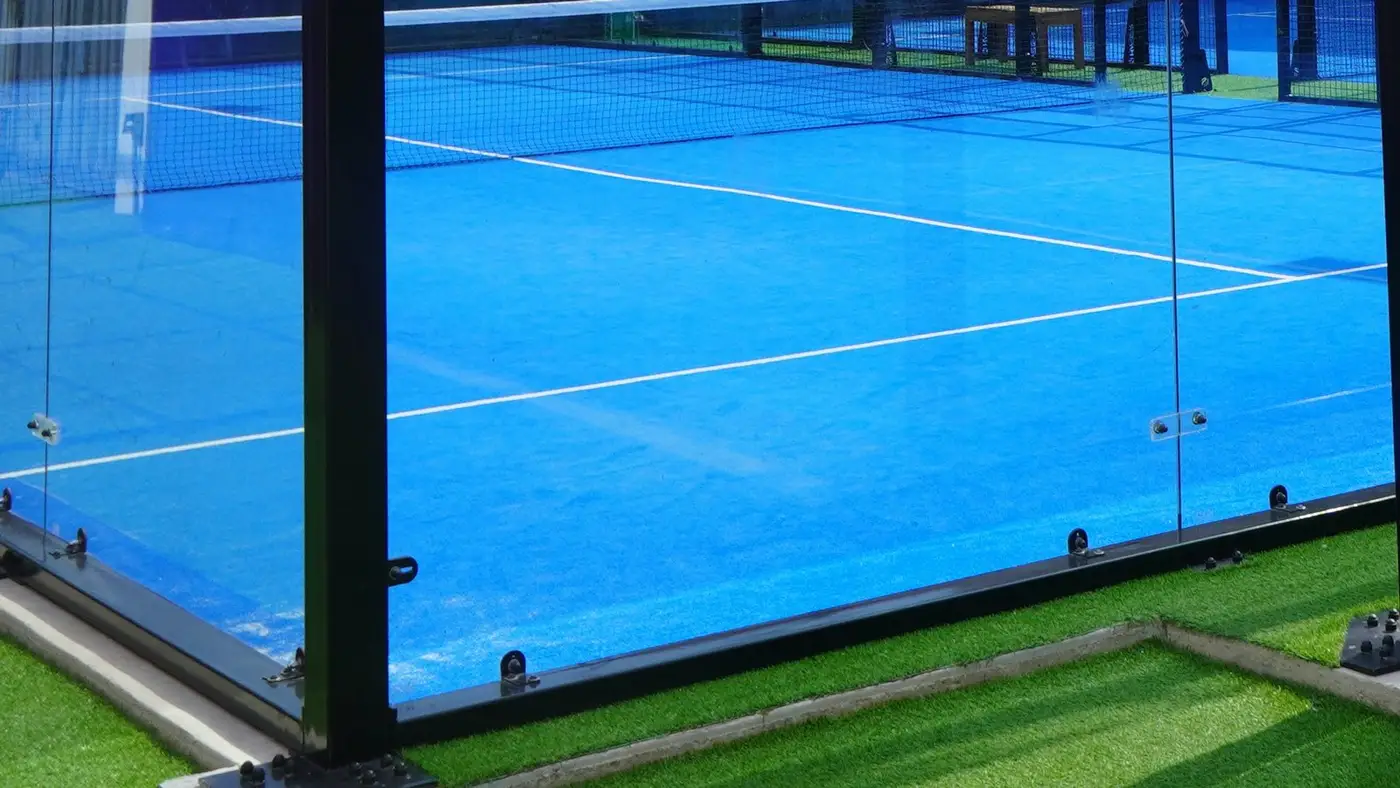
Padel is a doubles racket sport played on a fully enclosed court, with walls that are part of the game. Players use a solid, perforated padel racket (often called a paddle in the US) and a rubber ball, and they start every point with an underhand serve.
If you have seen a glass-walled court go up near a tennis club or in a converted warehouse, that is probably padel. It looks a little like tennis, shares some DNA with pickleball, and then does something neither of those sports does: after the ball bounces, you can play it off the walls. The court is compact and closed, so beginners can get into rallies sooner than on an open tennis court, and the underhand, at-or-below-the-waist serve makes it easier to put a point in play.
For a deeper walkthrough of the rulebook, see Padel rules and scoring. For a fuller side-by-side with tennis and pickleball, see Padel vs pickleball. For a first-session walkthrough, see How to play padel.
What is padel?
Padel (sometimes written pádel in Spanish) is a racket sport governed internationally by the International Padel Federation (FIP). Official play is doubles: two pairs, one on each side of the net, on a court that must be completely enclosed. The server starts the point, and the player diagonally opposite receives; the other three players may stand anywhere on their own side.
The official court is 10 meters wide by 20 meters long, measured on the inside (about 33 feet by 66 feet), with a mix of walls — often glass — and metal mesh. After the ball bounces in the opponents’ court, it may hit their walls or fence and still be in play, as long as it is returned before the second bounce. Rallies can last a long time, and placement and teamwork usually matter more than a huge serve. A ball that would be a winner in tennis can come off the glass and stay alive, so players learn to aim and to read a rebound, not just to swing hard.
The FIP, founded in Madrid on 12 July 1991, is the world governing body. As of 2026, its History page reports 100 affiliated federations, play in more than 150 countries, and approximately 35 million amateur players worldwide. The official professional tour, Premier Padel, was established in 2022 and is governed by the FIP.
Where padel came from
According to the FIP’s official history, padel was invented in 1969 at Las Brisas, in a house owned by Enrique Corcuera in Acapulco, Mexico. Corcuera did not have enough space for a full-size tennis court, so he built a smaller 20 × 10-metre court, enclosed by 3-metre walls, with a tennis net in the center — the first padel court in history, according to the FIP. The first set of rules was drafted by his wife, Viviana, who presented them to him as a birthday gift.
The sport reached Spain and Argentina in the early 1970s. In 1997, Spain and Argentina agreed in Barcelona to unify the rules and standardize the name as Padel (it had often been called “Paddle” in Argentina).
In the United States, USA Padel (formerly the United States Padel Association, or USPA) dates the sport’s arrival to 1993, when Ed Thompson and Felipe Arnold introduced it at the Houstonian Hotel Club and Spa in Houston, Texas. The first court was built there in 1994, a year also cited in a 29 June 2026 announcement by USA Padel president Bill Ullman, who referred to “that first court in the United States in 1994.”
The padel court
These measurements come from the FIP Rules of Padel, in the revision applicable from 1 January 2026. For line widths, tolerances, and post heights, see Padel rules and scoring.
The playing area is a rectangle 10 meters wide by 20 meters long (interior measurements). A net divides it in half. On each side, a service line runs parallel to the net at 6.95 meters (about 22 feet 10 inches) from the net. Minimum unobstructed height is 6 meters (about 20 feet); for new facilities, the FIP suggests 8 meters.
The net is 10 meters long. It stands 0.88 meters high at the center (about 35 inches) and rises to 0.92 meters at the ends (about 36 inches).
The court must be completely enclosed. At each end, the enclosure is 4 meters high in total: typically the first 3 meters are a wall (glass or another material that gives a uniform bounce), and the last 1 meter is metallic fence. The sides combine wall sections with metal mesh. The walls have to be hard, smooth, and consistent. The fence is also in play, though the bounce off mesh is less uniform than off glass.
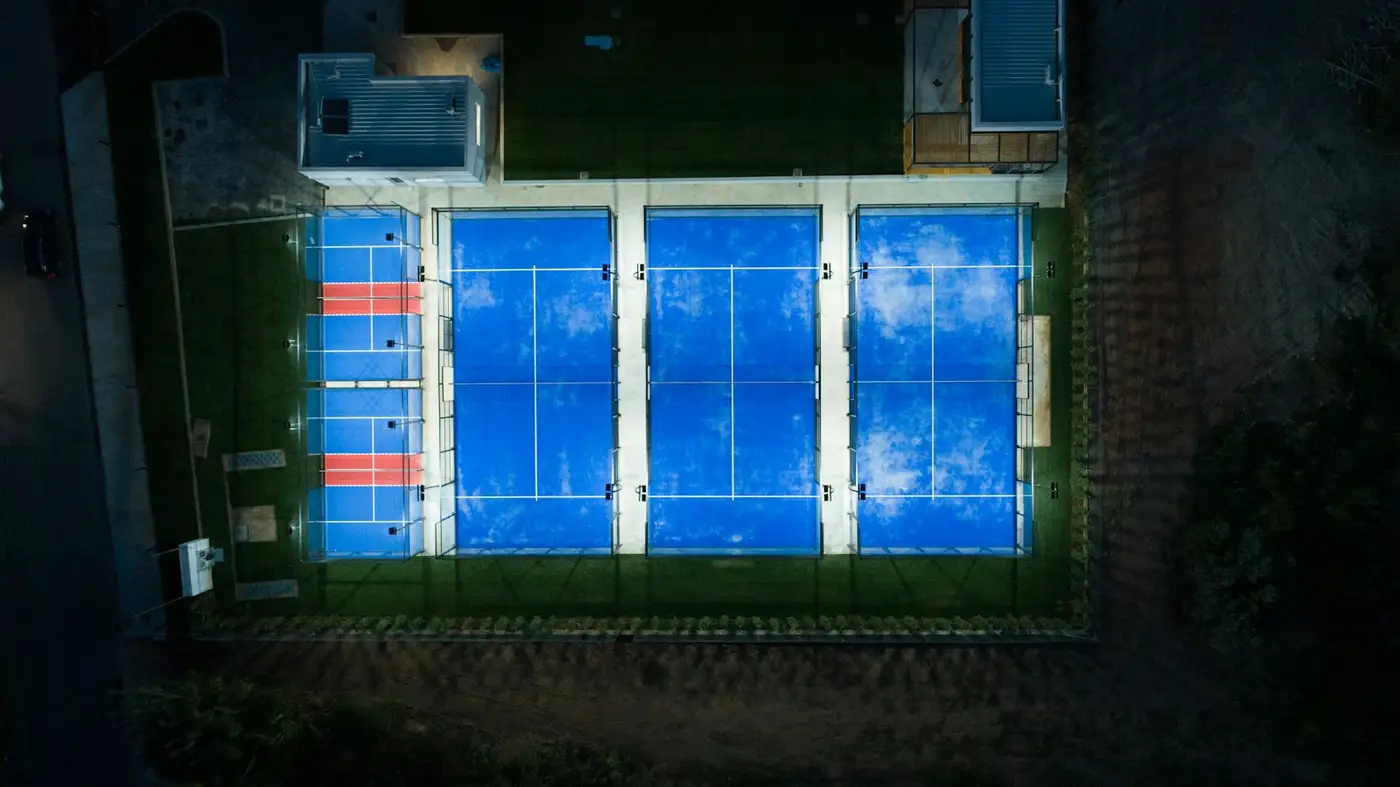
Photo by P-squared Padel on Unsplash
Equipment: the racket and the ball
The racket has a solid, stringless face with holes through it, not a strung tennis racket. Under the FIP Rules of Padel, total length may not exceed 45.5 centimeters. A non-elastic wrist cord, no longer than 35 centimeters, must be worn around the wrist; in official play, that cord is obligatory.
The ball is a rubber sphere, usually white or yellow. Official balls must be FIP-approved. They measure 6.35 to 6.77 centimeters in diameter and weigh 56.0 to 59.4 grams.
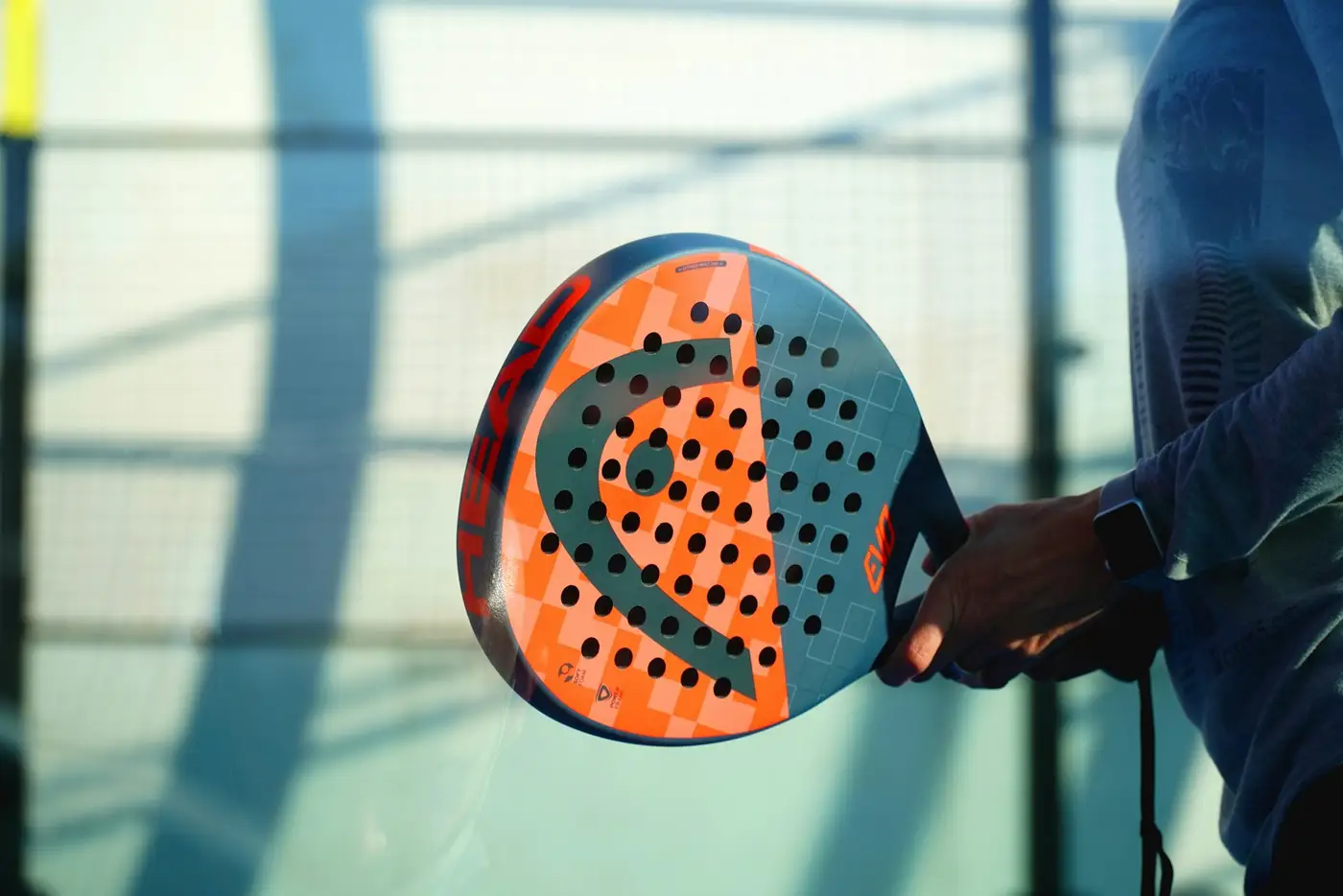
Photo by Manuel Pappacena on Unsplash
How scoring works
If you already know tennis scoring, you are most of the way there. The FIP Rules of Padel still use 15, 30, 40, and game, and a standard match is the best of three sets.
The familiar tennis-style option
Under Option 1 (Advantage) in FIP Rule 1, points are called 15, 30, 40, and game. At 40-40, the score is deuce, and a pair must win two consecutive points to take the game. The first pair to win six games, by a margin of at least two, wins the set. At 6-6, a tie-break is played: first to seven points, win by two.
That is the traditional method, and many recreational groups still use it. The FIP rulebook also lists two other ways to finish a game at deuce, plus optional shorter set formats, including a match-deciding super tie-break to 10 points.
Golden point (punto de oro)
Option 3 is the “no advantage” method, officially called the golden point and widely known in Spanish as punto de oro. At deuce, one deciding point is played. The receiving pair chooses the right or left side and may not switch places. The pair that wins the golden point wins the game. In mixed matches, the player who receives must be the same sex as the server. You will still hear this method at many clubs, even though official professional circuits have moved to a newer alternative in 2026.
Star Point: the 2026 professional change
Option 2 in the 2026 FIP rules is the Star Point system, unanimously approved by the FIP General Assembly on 28 November 2025.
At 40-40, each pair gets up to two chances to win the game on advantage: deuce 1 to advantage 1, then, if that is not converted, deuce 2 to advantage 2. If neither advantage is converted, a single deciding Star Point is played. The receiving pair chooses the side and cannot change positions. The winner of that point wins the game.
The FIP has described the change as a way to keep a taste of traditional advantage play while capping very long games. Professional circuits use Star Point in 2026; if you are booking a court with friends, ask what the house rule is. All three methods are in the official rulebook; a fuller walkthrough is in Padel rules and scoring.
Key rules beginners should know
A handful of rules will get you through a first session. The rest can wait for Padel rules and scoring.
The serve is underhand, at or below the waist. Every point starts with a serve, and the server gets a second serve if the first is a fault. Under FIP Rule 6, the server must stand with one foot behind the service line, between the imaginary prolongation of the central line of serve and the sidewall, and remain there until the ball has been served; bounce the ball in that box, and strike it at or below waist height with at least one foot on the ground. The serve is hit diagonally into the opponent’s service box; the lines count as in. A serve that then touches the metallic fence before the second bounce is a fault. There is no overhead serve.
The ball must bounce before it hits the walls — on the way in. A ball can hit the walls or mesh on the opponents’ side and still be live, but only after it has bounced on the floor in their court. You cannot hit the opposite glass or fence on the fly and call it good. You may use the walls on your own side before sending the ball back, including letting it come off the back glass or playing it onto your own wall so that it then bounces in the opponents’ court. A second bounce on the floor ends the point.
One player, one hit. Only one partner may hit the ball. A double hit, or a ball that strikes a player, their clothing, or the mesh or ground on their own side after they have hit it, loses the point.
Out-of-court play is not automatic. Movement around the back glass is normal. On courts with an official safety area, the rules also authorize leaving the enclosure to retrieve a ball that has gone out through a door or over a side wall. Many recreational courts are not set up for that. If the club has not authorized out-of-court play, you stay inside.
The official text is in the FIP Rules of Padel (applicable 1 January 2026).
Padel vs pickleball
This is the short version. For the full comparison, see Padel vs pickleball.
| Padel | Tennis | Pickleball | |
|---|---|---|---|
| Court | Enclosed 10 m × 20 m (about 33 × 66 ft), walls in play | Open court, 78 ft long; 27 ft wide (singles), 36 ft (doubles) | Open court, 20 × 44 ft |
| Net (center) | 0.88 m (about 35 in); 0.92 m at the ends | 3 ft (0.914 m) | 34 in (36 in at sidelines) |
| Format | Officially doubles | Singles and doubles | Singles and doubles |
| Equipment | Solid, perforated racket; rubber ball | Strung racket; felted tennis ball | Solid paddle; perforated plastic ball |
| Serve | Underhand, at or below the waist, after a bounce | Overhead serve allowed | Underhand, below the waist |
| Walls | In play after a bounce in the opponent’s court | Not in play | Not in play |
| Scoring | Tennis-style 15-30-40, plus optional golden point or Star Point | Tennis-style 15-30-40, with advantage | Typically side-out scoring to 11, win by 2 |
Padel and tennis share the 15-30-40 language. Padel and pickleball share a solid, stringless hitting surface and an underhand serve. Only padel uses an enclosed glass-and-mesh court as part of everyday rally play, and only pickleball has a non-volley zone (the kitchen) and the two-bounce rule.
How to start playing padel in the United States
You do not need to join a national association to try the sport. A good first step is to find a club, book an intro clinic, and borrow a racket. Many clubs run intro clinics and beginner open play, so you can show up without a pre-arranged foursome. For a session-by-session walkthrough of the basic shots, see How to play padel.
USA Padel (formerly the United States Padel Association, or USPA) is the national governing body for padel in the United States, recognized by the FIP and by Padel America. On 29 June 2026, it officially changed its name from USPA to USA Padel. Its resources still live at padelusa.org, with a planned move of the primary site to usapadel.org.
Find a court on USA Padel’s Where to Play page, which hosts an interactive club map of Premier, Official, and Registered clubs. Then look for an “Intro to Padel,” “Padel 101,” welcome class, or beginner clinic. In October 2026, USA Padel launched a New Player Program Finder, powered by Padel Browser; at launch it listed nearly 80 clubs in 25 states, and many first sessions were free or low-cost, with equipment provided.
A USA Padel membership is $50 per year (checked Nov 10, 2026), and member terms state that membership is valid for one year from registration. It is required for sanctioned tournaments, endorsed leagues, and a national ranking, but not for a first lesson. In its June 2026 announcement, USA Padel said it sanctions more than 250 tournaments a year and serves over 10,000 players, including the US Open Padel Championships.
Frequently asked questions
Is padel the same as pickleball or paddle tennis?
No. It shares a solid, stringless hitting surface and an underhand serve with pickleball, and tennis-style scoring with tennis, but the enclosed court and official doubles format make it a different game. See Padel vs pickleball.
Can you play padel singles?
Official FIP padel is doubles, with four players on court. A standard game, clinic, or tournament is doubles. Some clubs play social singles, but official matches are doubles.
Do I need my own racket to start?
Usually not. Intro clinics and many first sessions at US clubs provide rackets and balls.
Sources
All figures and rules claims in this article were checked against the following pages and documents, which were opened for this draft:
- International Padel Federation, Rules of Padel (review applicable 1 January 2026). Also listed on the FIP Documents page.
- International Padel Federation, History.
- International Padel Federation, Focus on… Mexico: Where it all began (19 March 2024).
- International Padel Federation, Between innovation and tradition: introducing the “Star Point” (18 December 2025).
- International Padel Federation and Premier Padel, 2026 Qatar Airways Premier Padel Tour calendar and Star Point announcement (18 December 2025).
- USA Padel, About Us.
- USA Padel, History.
- USA Padel, Where to Play.
- USA Padel, USA Padel Unveils New Name After More Than Three Decades Growing the Sport (29 June 2026).
- USA Padel, Membership Benefits.
- USA Padel, Membership Terms and Conditions.
- USA Padel, USPA Launches Interactive Club Map to Support Padel’s Growth (18 February 2026).
- USA Padel, National Padel Month Kicks Off: Your Guide to October (30 September 2026).
- USTA, Friend at Court 2026 (ITF Rules of Tennis, Rule 1, The Court).
- USA Pickleball, What Is Pickleball?.