Padel rules and scoring explained
Padel looks familiar if you already know tennis, but the enclosed court and underhand serve change how a point is played. This guide covers the official rules in plain English: the court, the serve, the walls, and how scoring works.
Two rulebooks matter for US readers: the International Padel Federation (FIP) Rules of Padel, in force from 1 January 2026, and the USA Padel (formerly United States Padel Association, or USPA) Rules and Regulations, updated 1 March 2026. USA Padel is the national governing body. Its handbook says that anything it does not cover is governed by the FIP rules.
New to the sport? Start with what padel is, or see padel vs pickleball.
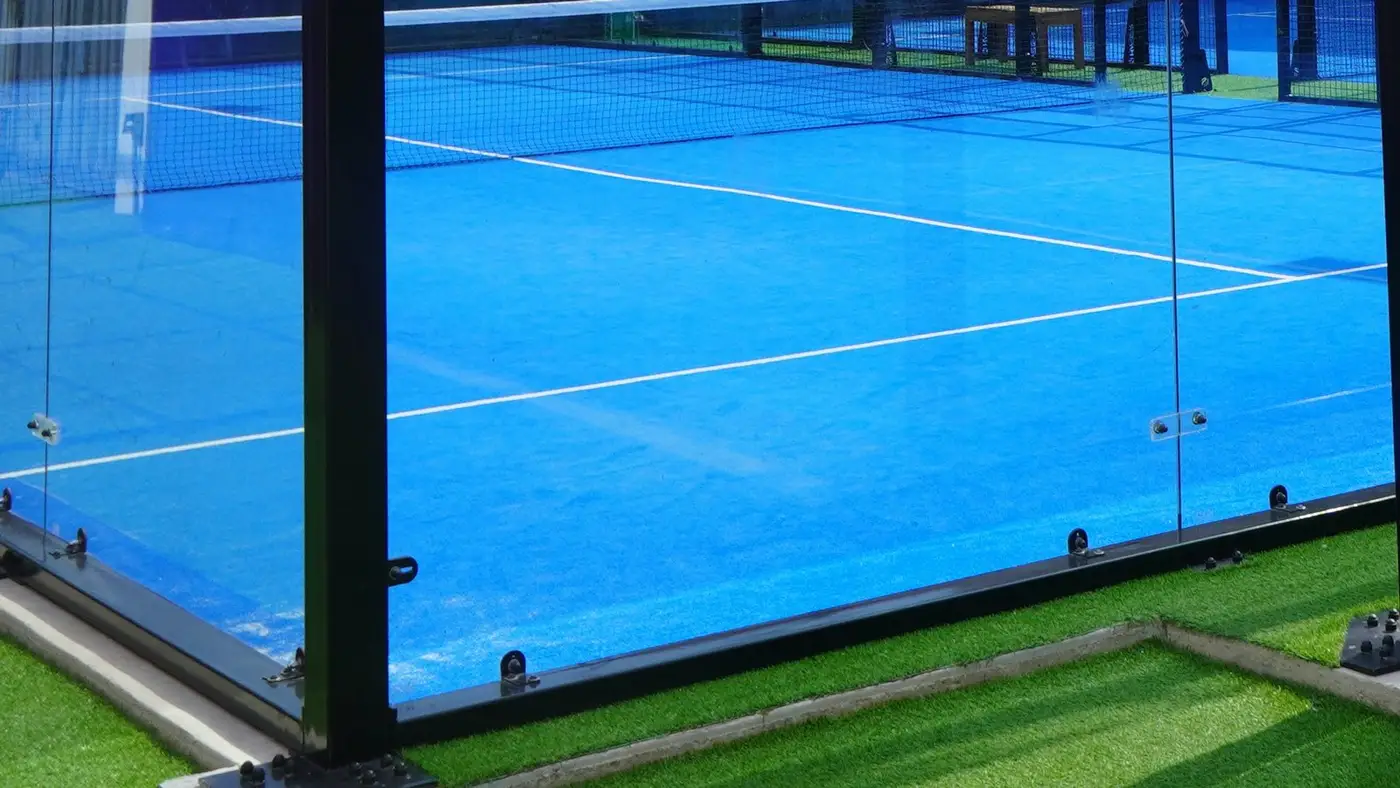
Photo by Bruno Vaccaro Vercellino on Unsplash
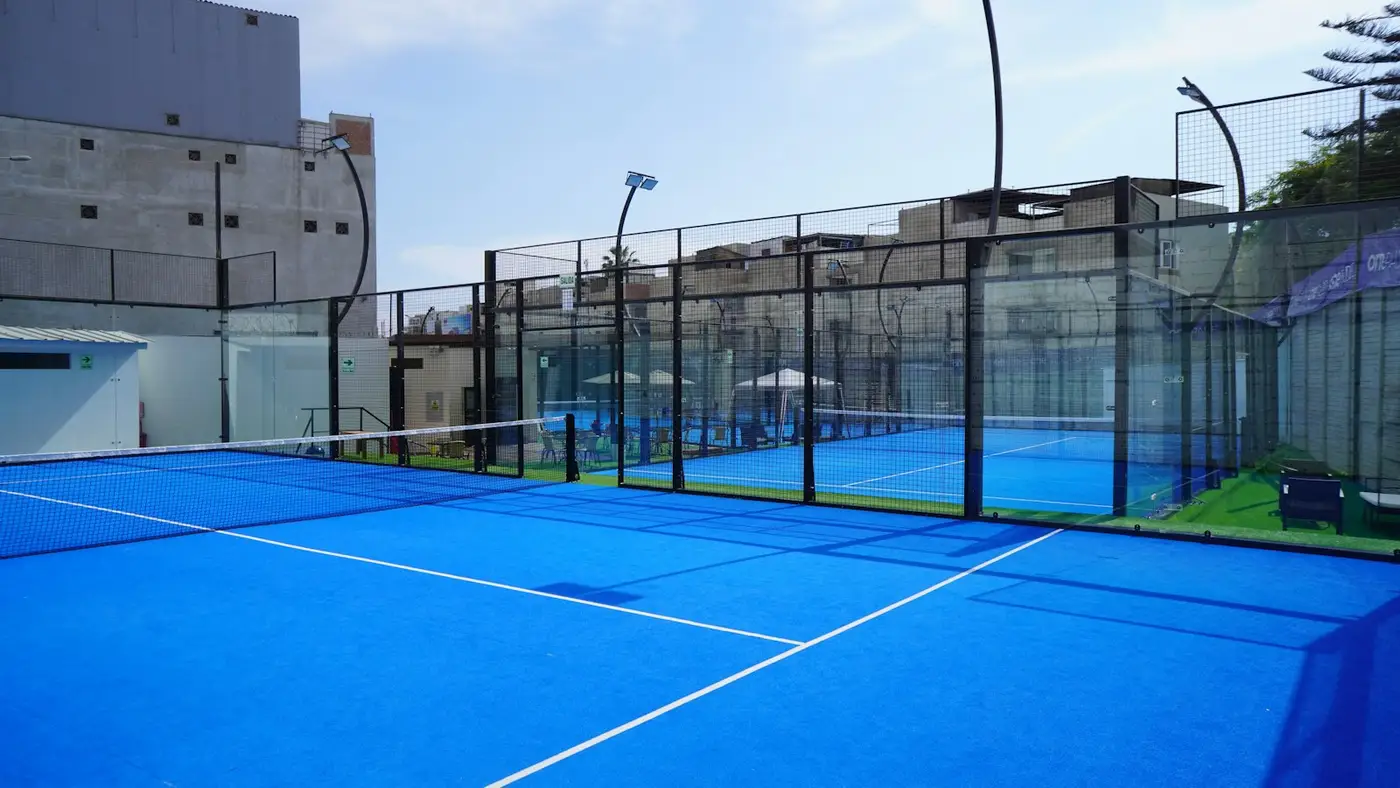
The court, net, and walls
A regulation padel court is a rectangle 10 meters wide by 20 meters long (about 33 by 66 feet), measured on the inside, with a 0.5% tolerance, according to the FIP Rules of Padel. A net divides it in half. Service lines sit 6.95 meters from the net on each side, and a central service line splits each service area in two.
The same rulebook sets the net at 0.88 meters high at the center and 0.92 meters at the ends. The court must be fully enclosed. At the ends, the enclosure is 4 meters high: the first 3 meters are a wall (usually glass), and the last meter is metallic fence. The sides use one of two approved wall-and-fence layouts. Clear height over the court must be at least 6 meters (the FIP suggests 8 meters for new facilities).
Those walls are not just a backdrop. After the ball bounces on your side, it can rebound off the walls or fence and still be in play.
The racket and the ball
The official equipment is a padel racket (often called a paddle in the US) and a padel ball. The racket has a solid, perforated face and no strings. Under the FIP rules, its total length may not exceed 45.5 centimeters, and it must have a non-elastic wrist cord no longer than 35 centimeters, worn around the wrist.
The ball is a rubber sphere, usually white or yellow. Official FIP measurements are a diameter of 6.35 to 6.77 centimeters, a weight of 56.0 to 59.4 grams, and a bounce of 135 to 145 centimeters when dropped onto a hard surface from 2.54 meters. Official competitions use FIP-approved balls. Many US clubs rent rackets if you are just starting; see how to play padel for first-session basics.
How a point is played
Padel is written as a doubles game: two pairs, one on each side of the net. Each point starts with a serve. After that, the pairs hit the ball alternately.
A few rules decide almost every beginner argument:
- The ball may bounce only once on your side before you return it. A second bounce loses the point.
- When you send the ball to the other side, it must bounce on the opponents’ floor before it hits their walls or fence. A shot that flies straight into the opposite glass or mesh is not a legal return.
- After a correct bounce on your side, the ball may hit the walls or metallic fence and stay in play. You can also play it off your own walls, as long as it then lands in the opponents’ court.
- Lines count as in, including on the serve.
- You lose the point if you, your racket, or anything you wear or carry touches the net or the opponents’ court while the ball is in play, if both partners hit the ball, or if the safety cord breaks or a player drops the racket.
Some clubs also allow out-of-court play, where a player may leave the enclosure to retrieve a ball. That is legal only when the court has the required safety area. Otherwise, a ball that leaves the enclosure ends the point.

Photo by Ernesto Samaniego on Unsplash
The serve
Every point begins with a serve, and the server gets two attempts.
The FIP service rules, including the 2026 wording, are specific:
- At the start of the service, stand with one foot behind the service line, between the imaginary prolongation of the central line of serve and the sidewall (service box), and remain there until the ball has been served. (FIP Rule 6)
- Bounce the ball on the ground, within the corresponding box in which you are to serve. The ball may not cross the service line or the imaginary line until it is struck.
- Do not touch the service line with your feet, nor the imaginary central line.
- Strike the ball at or below waist height, with at least one foot in contact with the ground. There is no overhead serve.
- Serve diagonally into the opposite service box. The first serve of a game is from the right side to the receiver’s left box; sides then alternate after each point.
The receiver must let the serve bounce in the correct box and hit it before the second bounce. Volleying the return of serve is not allowed. Partners may stand anywhere on their own side.
A serve is a fault if it misses the correct box (lines are good), the server misses the ball, or the ball bounces in the correct box and then touches the metallic fence before the second bounce. A serve that clips the net or posts and then lands in the correct box, without touching the fence before the second bounce, is a let and is replayed. Partners choose who serves and who receives first in each set; that order stays fixed until the next set.
Scoring: points, games, sets, and matches
The basic language will sound like tennis. Under FIP Rule 1, the first point won is called 15, the second 30, the third 40, and the fourth game — unless both pairs have won three points, which is deuce.
A set is won by the first pair to win six games, with a margin of two. At 6-6, the players play a tie-break. A standard match is the best of three sets.
In a tie-break, points are called 0, 1, 2, 3, and so on. The first pair to seven points, leading by two, wins the tie-break and the set (7-6). The player due to serve starts with one serve from the right; after that, players serve two points at a time in the same order. Ends change after every six points (FIP Rule 5).
The FIP also allows shorter formats when they are announced in advance: mini-sets (first to four games, with a tie-break at 4-4), a 7-point match tie-break in place of a third set, or a super tie-break to 10 points in place of a third set. Agree the format before you start, especially if court time is limited.
Advantage, Star Point, and Golden Point
What happens at deuce is where club and tournament scoring can differ. The 2026 FIP rulebook lists three options.
Option 1: Advantage (classic scoring). After deuce, the next point is advantage. Win the following point and you win the game; lose it and the score returns to deuce. Play continues until one pair wins two points in a row.
Option 2: Star Point. This newer format was approved by the FIP General Assembly on 28 November 2025 and is described in the FIP’s Star Point announcement. It still allows advantage play, but it caps how long a game can last. At the first deuce, play a point for advantage 1. Win it, and you win the game; lose it, and the score returns to deuce. The same happens at advantage 2. If that second advantage is also lost, the game goes to the Star Point: one deciding point. The receiving pair chooses whether to receive on the right or the left and may not switch positions. In mixed matches, the receiver must be the same sex as the server.
Option 3: Golden Point (no advantage). At deuce, the pairs play one deciding point, and the winner of that point wins the game. As with Star Point, the receiving pair chooses the side and may not change positions; in mixed matches the receiver is the same sex as the server.
Club sessions may use any of these. Ask before you play so you are not arguing at 40-40.
What USA Padel tournaments use
For sanctioned events in the United States, you do not have to guess. The USA Padel / USPA Rules and Regulations (1 March 2026) state that Star Point is used in all USPA-sanctioned tournaments and matches. On the Star Point, the receiving team chooses the serve side.
Match length depends on the event and division. In USPA 2000, 1000, and 500 events, Division 1 main-draw matches are best of three tie-break sets. Main-draw matches in Divisions 2, 3, and 4, consolation matches in those events, and all matches at USPA 250 and 100 events are two tie-break sets with a 10-point super tie-break in place of a third set. All of those tie-breaks must be won by two points.
The organization rebranded to USA Padel on 29 June 2026. The March 2026 rulebook still uses the USPA name. Resources remain at padelusa.org and usapadel.org.
A few official timing rules
The FIP does not set a fixed match length, but Rule 2 does set the clock between points: a maximum of 20 seconds between points, 90 seconds on a change of ends, and 120 seconds at the end of a set. After the first game of each set, and during a tie-break, play is continuous on the change of ends. There is an obligatory three-minute courtesy rally before the match, and USA Padel’s handbook (section 5.9) uses the same three-minute warm-up in sanctioned events.
If you are booking a social court, the club’s slot length will matter more than these figures.
Quick answers to common questions
Can you volley in padel? Yes, except on the return of serve. The receiver has to let the serve bounce.
Is a ball that hits the glass out? Not if it bounced in the court first. A shot that hits the opponents’ wall or fence without bouncing on their floor is not legal.
Do you change ends? Yes. Under FIP Rule 5, players change sides after the 1st, 3rd, and every following odd game, and after every six points in a tie-break.
Is singles official? The FIP and USA Padel competition rules are written for pairs. Some clubs play social singles, but official matches are doubles.
Start with a legal serve, let the ball bounce on the other side before it finds the glass, and agree the scoring format before the first point.