Padel vs pickleball (and how both compare to tennis)
Padel and pickleball get compared a lot in the US: both use a solid, stringless implement, start with an underhand serve, and are often played as doubles. They are still different sports. This guide leads with that comparison, then shows where tennis fits as a third reference point.
The measurements and rules below come from official sources, not impressions from a casual hit. For padel, that means the FIP Rules of Padel. For pickleball, USA Pickleball’s overview and the 2026 Official Rulebook. For tennis, the ITF Rules of Tennis (2026); the court and net figures also appear in USTA Friend at Court 2026.
If you only need the padel side in more depth, see what padel is and padel rules and scoring.
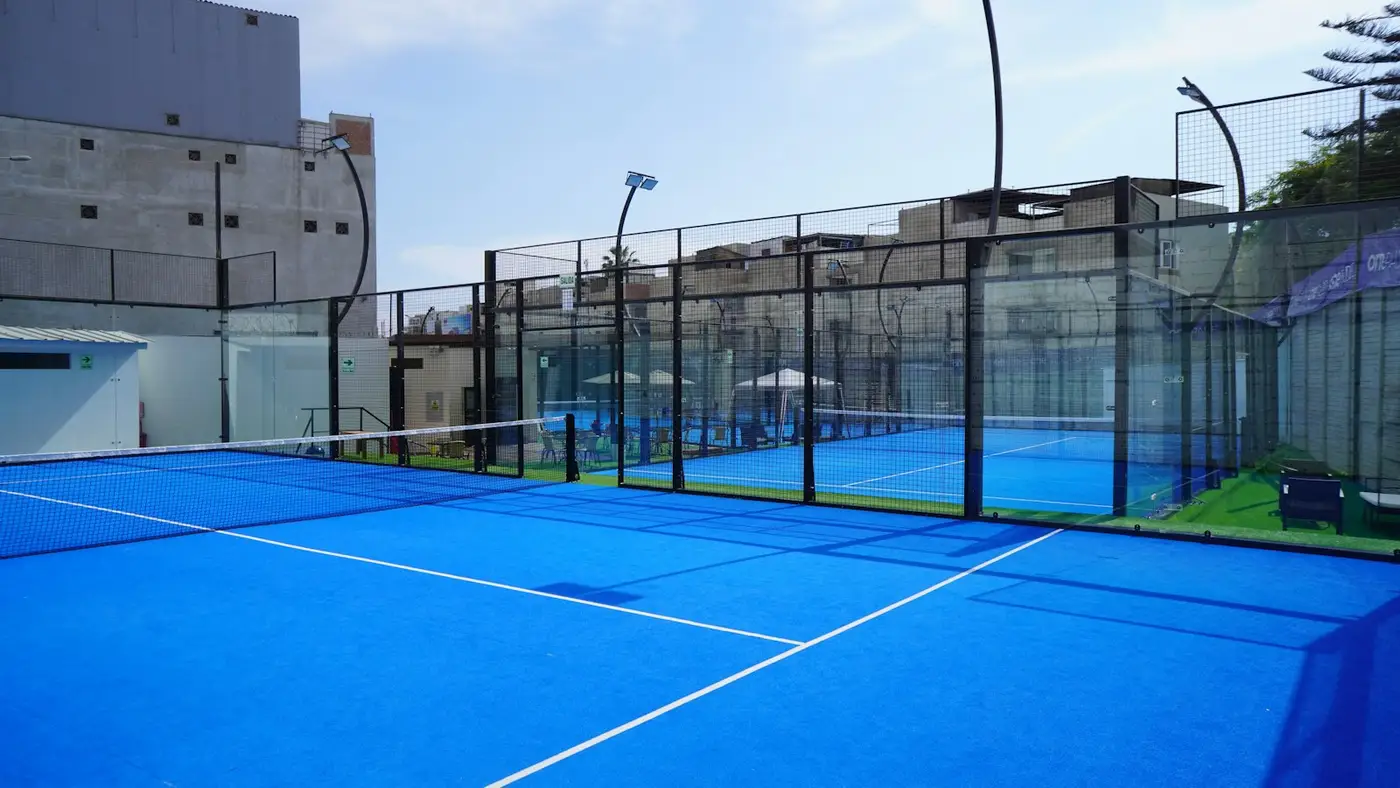
Photo by Bruno Vaccaro Vercellino on Unsplash
At a glance
| Padel | Pickleball | Tennis | |
|---|---|---|---|
| Court | 10 m × 20 m, fully enclosed | 20 ft × 44 ft (6.10 m × 13.41 m), open | 23.77 m long; 8.23 m wide (singles) or 10.97 m wide (doubles); open |
| Net height | 0.88 m at center, 0.92 m at the ends | 34 in (86.36 cm) at center, 36 in (91.44 cm) at the sidelines | 0.914 m (3 ft) at center, 1.07 m (3.5 ft) at the posts |
| Walls | Yes. After a bounce, the ball may be played off the walls and fence | No. There is no wall play | No. Walls and fences are out of play |
| Typical format | Official rules are written for doubles | Singles or doubles | Singles or doubles |
| Implement | Solid, perforated padel racket (often called a paddle in the US), no strings; max length 45.5 cm; wrist cord required | Solid paddle of rigid material; max length 17 in (43.18 cm) | Strung racket; max length 73.7 cm (29 in) |
| Ball | Rubber sphere; official FIP diameter 6.35–6.77 cm, weight 56.0–59.4 g; bounce 135–145 cm from 2.54 m | Perforated plastic ball (USA Pickleball: 26–40 circular holes) | Felt-covered tennis ball; ITF Type 2 diameter 6.54–6.86 cm, mass 56.0–59.4 g; rebound 135–147 cm |
| Serve | Underhand, after a bounce, at or below the waist, diagonal, two serves | Underhand, below the waist, diagonal; volley serve or drop serve | Ball is struck before it bounces; two serves |
| Scoring | 15, 30, 40, game; sets usually to six games | Standard scoring: only the serving side scores; games typically to 11, win by 2 | 15, 30, 40, game; sets usually to six games; matches may be best of three or five |
| Signature rule | Walls stay in play after the bounce | The non-volley zone (“kitchen”) and the two-bounce rule | Open court; the serve may be hit overhead |
Figures: padel from the FIP Rules of Padel (in force 1 January 2026); pickleball from the USA Pickleball 2026 Official Rulebook and USA Pickleball’s overview (the 26–40-hole ball range is from the overview); tennis court, net, and racket from the ITF Rules of Tennis (2026), with the same court and net figures in USTA Friend at Court 2026. The Type 2 tennis ball size, mass, and rebound ranges are from ITF Appendix I. Court areas in the next section are calculated from those official dimensions.
Courts: size, enclosure, and the kitchen
Padel and pickleball courts are not close in size, and only one of them is enclosed.
A padel court is 10 meters wide by 20 meters long, fully enclosed by walls and metallic fence, with a net 0.88 meters high at the center. Service lines are 6.95 meters from the net. Those figures come from the FIP rulebook.
A pickleball court is smaller, and open: 20 feet (6.10 m) wide by 44 feet (13.41 m) long for both singles and doubles, according to the 2026 USA Pickleball rulebook (Rule 3.A.1). The net is 36 inches at the sidelines and 34 inches at the center (Rules 3.B.6–3.B.7). Each side has a 7-foot non-volley zone, commonly called the kitchen (Rule 3.A.4.c). Players may not volley while touching that zone. Padel has no equivalent area.
A tennis court, under ITF Rule 1, is a rectangle 78 feet (23.77 m) long. It is 27 feet (8.23 m) wide for singles and 36 feet (10.97 m) wide for doubles. The net is 3 feet (0.914 m) at the center and 3½ feet (1.07 m) at the posts. Those court and net measurements also appear in USTA Friend at Court 2026. The court is open: a ball that lands outside the lines, or hits a fence or backstop before bouncing in, is not in play.
You will sometimes see padel described as “about a third the size of a tennis court.” The official playing areas do not support that shorthand. Calculated from those official dimensions, a padel court covers 200 square meters (10 × 20). A tennis singles court is about 196 square meters (23.77 × 8.23); a tennis doubles court is about 261 square meters (23.77 × 10.97). Padel is shorter than tennis and only slightly narrower than a doubles tennis court. It feels more compact because the walls close in the space and remove the run-back behind the baseline. A pickleball court is smaller still, at about 82 square meters (13.41 × 6.10).
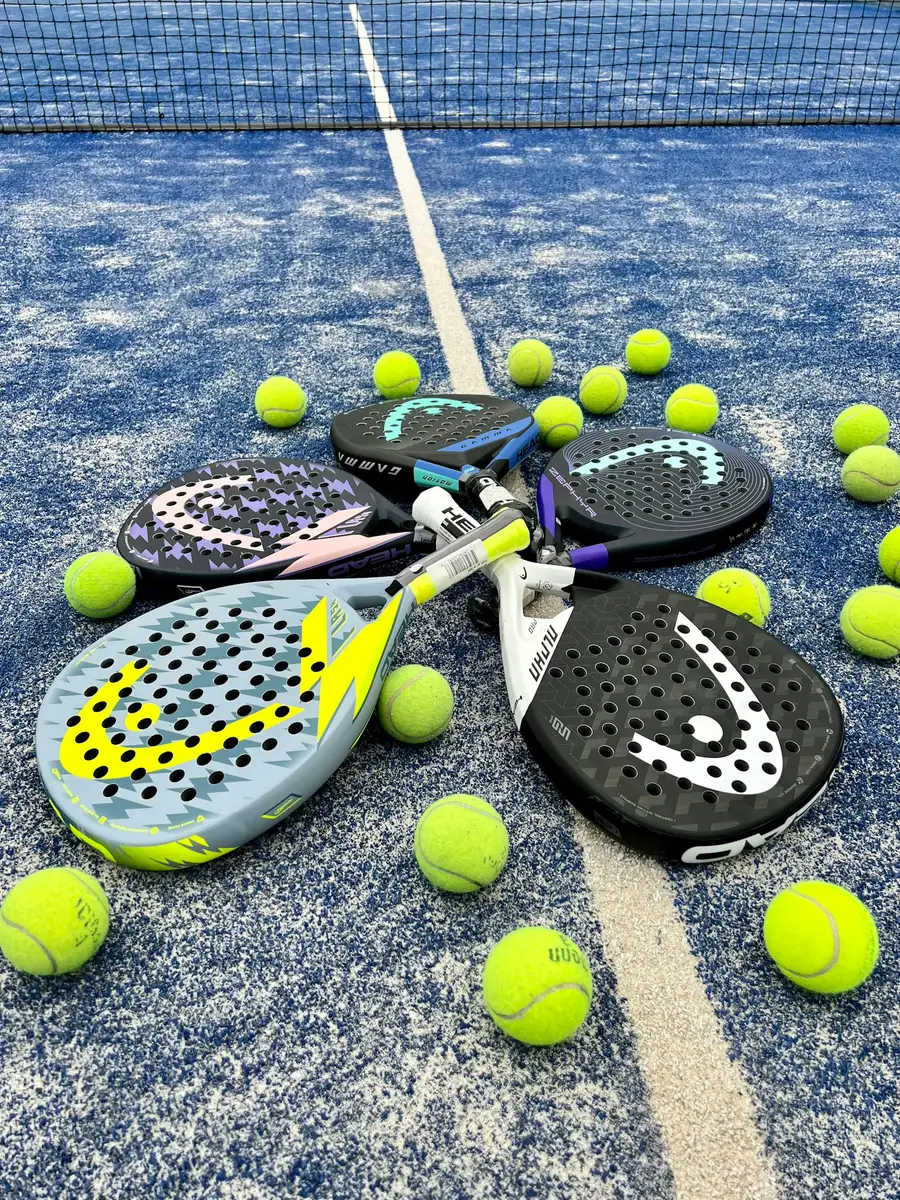
Photo by Sergio Contreras on Unsplash
Equipment
A padel racket has no strings. It is a solid, perforated face with a short handle. The FIP caps total length at 45.5 centimeters and requires a wrist cord.
A pickleball paddle is also solid and stringless, but it is built for a plastic ball. USA Pickleball limits paddle length to 17 inches (43.18 cm) and the combined length and width to 24 inches (Rule 3.D.2). A pickleball paddle or a tennis racket will not do as a substitute on a padel court.
A tennis racket, by contrast, is a strung frame. The ITF caps overall length at 73.7 centimeters (29 inches) and overall width at 31.7 centimeters (Appendix II).
The balls look less alike than people expect. A padel ball is a rubber sphere with the official FIP size, weight, and bounce ranges listed in the table above. A pickleball is a hard plastic ball with holes — USA Pickleball’s public overview specifies 26 to 40 circular holes. A standard tennis ball is felt-covered; an ITF Type 2 ball has a slightly larger diameter range than a padel ball and the same official weight range (56.0–59.4 grams).
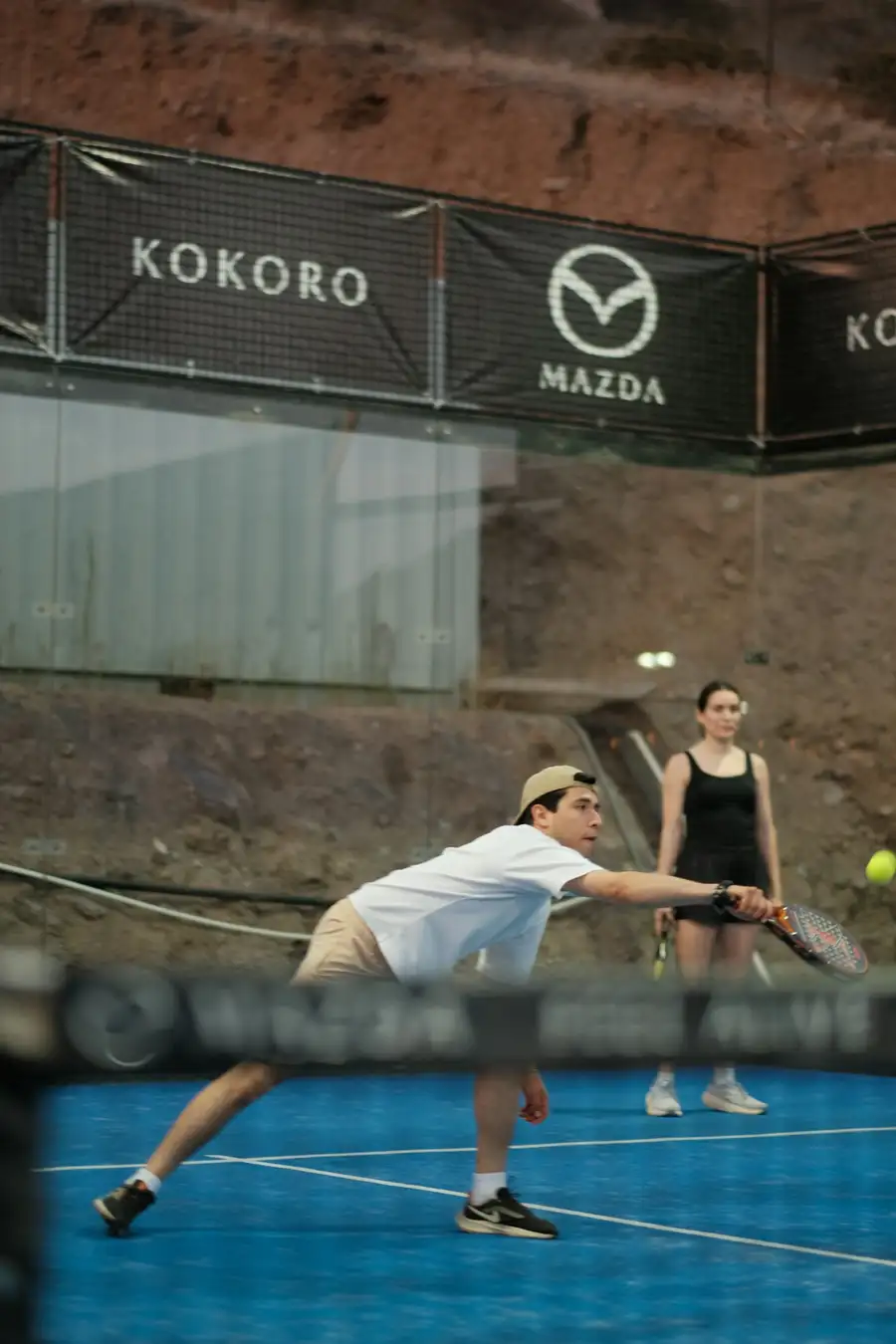
Photo by Ernesto Samaniego on Unsplash
Serve and how a point is played
All three sports serve diagonally into a service box. The motion and what happens next are different.
In padel, under FIP Rule 6, the serve must bounce in the server’s box and be struck at or below the waist, with at least one foot in contact with the ground. At the start of the service, the server must stand with one foot behind the service line, between the imaginary prolongation of the central line of serve and the sidewall (service box), and remain there until the ball has been served. The server gets two serves. The receiver has to let the serve bounce. After that, volleys are allowed. The distinctive rule is the walls: your shot must bounce on the opponents’ floor before it hits their glass or fence, but after it bounces on your side you may play it off the enclosure.
In pickleball, the serve is underhand and must be struck below the waist, either as a volley serve (hit before the bounce) or a drop serve (hit after the bounced ball), per the 2026 Official Rulebook (Section 7). The two-bounce rule requires the serve and the return of serve each to bounce before being volleyed. After those two bounces, volleys are allowed — except in the kitchen.
In tennis, the server stands behind the baseline and hits the ball before it bounces (ITF Rules 16–17). The serve may be overhead. The receiver must also let the serve bounce. After that, the point is played in an open court. There is no wall to keep a passing shot alive.
The result is three different rhythms. Pickleball rewards placement and patience around the kitchen. Padel rewards using the walls, moving forward as a pair, and constructing points in a smaller enclosed space. Tennis rewards covering a large open court.
Scoring
Padel and tennis share a scoring language. Points are 15, 30, 40, and game (FIP Rule 1; ITF Rule 5). At deuce, classic play uses advantage: a pair must win two points in a row to take the game. A set is usually first to six games, with a two-game margin, and a tie-break at 6-6. A standard padel match is the best of three sets. Tennis matches may be the best of three or, in some events, the best of five.
Padel also has official alternatives at deuce. The 2026 FIP rulebook lists Advantage, Star Point, and Golden Point. Star Point still allows two advantage chances, then one deciding point. Golden Point is a single deciding point at the first deuce; the pair that wins it wins the game. USA Padel (formerly USPA) uses Star Point in all sanctioned tournaments and matches, as set out in its 1 March 2026 rules (section 3.6.1). Club sessions may use any of the three options, so it is worth asking before you play.
Pickleball scoring is a different system. In standard play, described by USA Pickleball and Rule 4.A, only the serving side can score. Games are typically played to 11 points, win by 2, though tournament formats may go to 15 or 21. In doubles, the score is called as three numbers (serving team’s score, receiving team’s score, and the server number). Rally scoring, in which either side can score, is a provisional option in the 2026 rulebook (Rule 14.A), not the default.
Who usually plays, and how social the formats are
Official padel is a doubles game. The FIP and USA Padel competition rules are written for pairs. You will usually need three other people, or a club that will help you make a four. Pickleball and tennis can be played as singles or doubles, which makes it easier to play with one other person.
That doubles-first structure is a large part of why padel clubs feel social, but it also affects how you book. If you are looking for a first court in the United States, a local club listing is the place to start.
Which sport might fit you
There is no official ranking of which sport is “easiest” or “best for fitness,” and this site will not invent one. A few practical differences are clear from the rules:
- Choose padel if you want a doubles game on an enclosed court, with an underhand serve and wall play, and you have (or can find) three other people. Coming from pickleball, the solid implement and underhand serve will feel familiar; the walls, the rubber ball, and tennis-style scoring will not.
- Choose pickleball if you want the smallest court, a plastic ball, singles or doubles, and rules built around the kitchen and the two-bounce sequence.
- Choose tennis if you want an open court, a strung racket, and the option of singles or doubles, including an overhead serve.
Many people play more than one. The equipment does not transfer cleanly — especially the racket or paddle and the ball — so plan to use the right gear for each court. If padel is your pick, start with how to play padel.